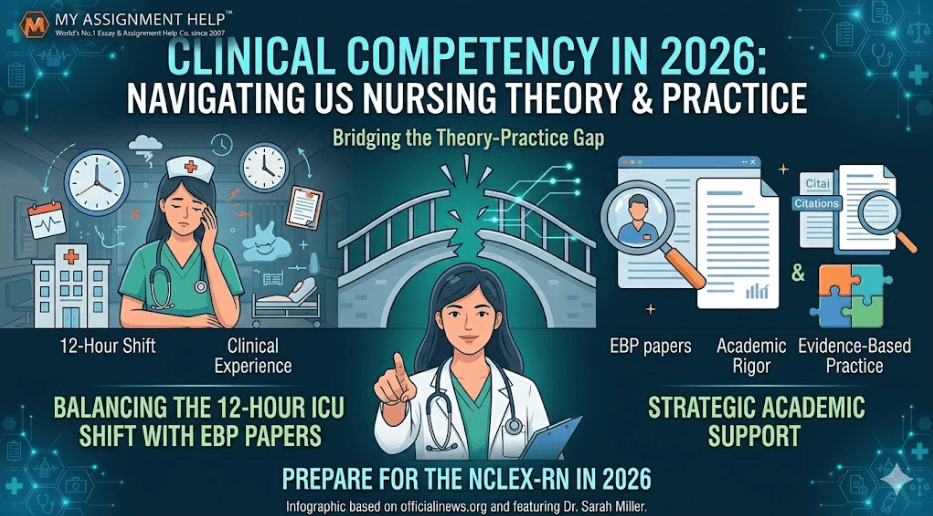
In 2026, the definition of a “competent nurse” has shifted. It’s no longer just about the precision of a bedside procedure; it’s about the ability to synthesize real-time patient analytics with Evidence-Based Practice (EBP). However, this intellectual demand has created a breaking point for students.
The “Theory-Practice Gap” is no longer a theoretical concept—it is a physical and mental hurdle. Today’s US nursing student is often caught between a 12-hour clinical rotation in a high-acuity unit and a midnight deadline for a 2,500-word reflective journal that must meet CCNE standards.
Case Study: The Midnight Burnout (NYC, 2026)
Consider “Jordan,” a Level 3 Nursing Student at a major New York university. After a grueling shift in the Trauma ICU, Jordan had less than six hours to submit a detailed care plan.
“I spent 12 hours on my feet, witnessing complex hemodynamics. By the time I got home, my brain was in ‘clinical mode,’ not ‘academic mode.’ I knew the science, but I couldn’t find the words to structure it into a formal paper. Without a tool to help me type my essay and organize my initial clinical observations into a coherent USA-standard outline, I would have missed my submission window entirely.”
This is the reality of nursing in 2026. The use of an automated tool isn’t about skipping the work; it’s about cognitive offloading—allowing the student to move from “clinical exhaustion” to “academic production” with minimal friction.
The AACN Essentials and the Pressure of “Perfect” Documentation
The American Association of Colleges of Nursing (AACN) has reinforced that clinical competency must be reflected in documentation. In 2026, a care plan that lacks recent, peer-reviewed citations is considered a clinical failure.
For many, the sheer volume of research required is the primary obstacle. This is where the strategic decision to buy nursing essay support becomes a critical academic maneuver. For a student specializing in Oncology or Pediatrics, having a professionally drafted model paper provides a “gold-standard” template. It ensures they aren’t just guessing at APA 7th edition formatting or EBP synthesis; they are learning from a high-level example that meets every US regulatory benchmark.
Experience-Led Expertise: The Senior Strategist’s View
From my perspective as a strategist at MyAssignmentHelp, we’ve seen a 40% increase in students requesting “Review and Edit” services for their clinical journals. They have the experience—they’ve seen the patients—but they need the academic polish to satisfy the “Authoritativeness” required by modern professors.
In the USA, where the NCLEX-RN now incorporates more case-study-based questions, the ability to write clearly about clinical experiences is directly tied to licensure success. We aren’t just providing essays; we are providing the “Theory” bridge that allows “Practice” to shine.
Conclusion: Future-Proofing through Strategic Support
The nursing students of 2026 are the most technologically savvy generation in history. They understand that success isn’t just about working harder; it’s about working smarter. By leveraging the right tools—whether it’s a quick-start interface to help them draft a response or a deep-dive nursing essay service for complex topics—they are ensuring that the US healthcare system remains staffed by nurses who are both clinically sharp and academically elite.
See also: Next-Gen Connectivity Solutions
Frequently Asked Questions (FAQ)
Q: How does the “Experience” factor influence nursing grades in 2026?
Professors now look for “Reflective Competency”—the ability to link a specific clinical moment (Experience) to a specific peer-reviewed study (Expertise).
Q: Is using an essay typer considered “cheating” in US nursing schools?
When used as a brainstorming or outlining tool to help a student “type my essay” faster, it is seen as a productivity aid, similar to using Grammarly or a citation generator.
Q: What is the biggest challenge for US nursing students this year?
“Clinical Saturation.” There are more students than clinical spots, making the hours spent on-site incredibly intense and leaving little room for theoretical research.
Author Bio:
Dr. Sarah Miller, Senior Content Strategist at MyAssignmentHelp With a Doctorate in Nursing Education and over a decade of experience in US curriculum development, Dr. Miller specializes in bridging the gap between clinical rotations and academic success. She has pioneered “Support-First” frameworks that help American nursing students maintain their GPA without sacrificing clinical performance.
Key Takeaways
- The 2026 Clinical Logjam: Why 12-hour shifts are making traditional assignment schedules obsolete.
- Case Study Insight: A real-world look at the “Theory-Practice Gap” in a New York teaching hospital.
- Regulatory Rigor: Navigating AACN Essentials without academic burnout.
- Strategic Outsourcing: When and why top-tier students utilize professional academic drafting.
References
- American Association of Colleges of Nursing (AACN). (2026). The 2026 Essentials: A New Era of Nursing Competency.
- National League for Nursing (NLN). (2025). Digital Tools and the Modern Nursing Student: A Policy Paper.
- U.S. Department of Health and Human Services. (2026). Nursing Workforce Projections and Educational Standards.
